Digital PR Link Building: How Campaigns Earn Editorial Links
A journalist ignored 200 pitches before breakfast, then opened one. This guide explains what made that pitch different, what digital PR campaigns really cost, and how to run one without promising what no campaign can promise.

Maya runs marketing for a small software company that helps dentists manage appointments. Her team had just surveyed 500 dental practices about no-shows, and the numbers were genuinely interesting: practices that sent a text reminder on the morning of the appointment cut no-shows by a third, while a call the day before barely moved the needle. Maya sent the survey to 60 journalists. Fifty-nine never replied. The one who did wrote a short story, linked to the survey page, and sent more traffic in a day than the blog had seen in a month. That single link is what digital PR link building is for. This guide explains how digital PR link building works, what it costs, how long it takes, and where it fails.
What Is Digital PR Link Building?
Digital PR link building is earning backlinks by giving journalists something worth writing about, usually original data, a newsworthy story, or expert comment, then pitching it to the reporters who cover that topic. The link is not bought, traded, or placed by the site owner. It appears because a journalist decided the story deserved coverage and linked to the source while writing it.
A campaign has three parts. First, the asset, something a newsroom can use: a survey, a dataset, a study, a map, or expert comment tied to a news event. Second, the media list: a short list of journalists who recently covered the same topic, built by reading their work, not by buying a database and blasting it. Third, the pitch: a short email that explains the story in two or three lines and points to the asset. When all three parts are strong, digital PR link building produces the hardest link to copy: an editorial link from a real publication, placed by a person who chose it.
Guest posting puts your article on someone else's site, and you control the link because you wrote the piece. A linkable asset sits on your own site and waits to be found, which works slowly unless someone promotes it. Digital PR is the promotion layer: it takes an asset, usually the kind of linkable assets that earn links on their own merits, and carries it into newsrooms. A campaign with a weak asset is just a loud email.
How Digital PR Link Building Differs From a Press Release
People often assume digital PR link building is the same as sending a press release. It is not, and the difference decides whether a campaign earns links or gets ignored.
Our guide on how to write a press release covers the format, and a good release still has its place for genuine company news, but an announcement about your own business is not a story a journalist needs to write.
A digital PR campaign starts from the opposite end. It asks what a journalist's readers would find interesting, then builds the asset to answer that question. The survey of 500 dental practices worked because the finding helped readers, not because it promoted the company. A study of rent prices across 40 cities or a survey of what people actually pay for a wedding is a story first and a brand mention second.
A press release goes out to hundreds of contacts at once, while a digital PR pitch goes to a small list, often 40 to 60 journalists, and each email names something the journalist recently wrote. The work is slower and more personal, which is exactly why it earns links a wire release does not.
Press releases also barely register in AI search. Muck Rack's May 2026 analysis of more than 25 million cited links found press releases account for under 1 percent of AI citations, while earned media accounts for 84 percent. A release still has its place for real news, but for links and AI visibility, a campaign built around original data is the stronger bet.

The Numbers Behind Digital PR Link Building
Editorial.Link surveyed 518 SEO professionals in 2025, and 48.6 percent named digital PR the most effective link building tactic, against 16 percent for guest posting and 12 percent for linkable assets. That is practitioner opinion from one survey, not a measurement; the Editorial.Link survey page reports the same figure. A second survey tells a similar but different story: Reporter Outreach surveyed 500 SEO professionals for its State of Link Building 2026 report, and 34 percent ranked digital PR as their top performing method, nearly double guest posting at 18 percent. These two figures come from different surveys with different samples and questions, so they must never be blended into one claim. Both point the same way, but neither proves the tactic works for any single site.
BuzzStream's State of Digital PR 2026 report, surveying more than 150 practitioners, adds the detail. Backlink acquisition remains the top goal for 85.8 percent of respondents. At the same time, 68.2 percent consider digital PR more effective than it was twelve months earlier, while 75 percent say it has become harder to execute. That is the honest picture of digital PR link building in 2026: it works better and it is harder to do. The same report finds 66.2 percent of teams now track AI citations as a KPI, a metric that did not exist in the 2025 edition. A clear summary of the BuzzStream 2026 findings, with the same figures, is published on the Fractl site.
On cost, BuzzStream 2026 reports the most common known cost per link is 300 to 500 dollars, reported by 19.6 percent of teams, with the agency side average around 750 dollars. The median digital PR retainer sits around 5,458 dollars per month, and roughly 60 percent of teams run under 10,000 dollars monthly. Note the wording: 300 to 500 dollars is the most common known band, not an average, and many teams do not know their cost per link at all.
On timing, BuzzStream 2026 reports 85.2 percent of practitioners see measurable results within six months, and 51.4 percent say results take three to six months. On the shorter end, 81 percent land first coverage within a week of pitching, and 29.9 percent within three to five days. First coverage is not the same as a followed link: a mention without a link is not a backlink, and many early pickups link to a homepage or not at all.
The AI search figures are correlation, not proof. An Ahrefs study of 75,000 brands, published in August 2025, found branded web mentions correlate with AI Overview visibility at 0.664, versus 0.218 for backlinks, roughly a three to one difference. That is a correlation only: mentions and AI visibility move together in that sample, which does not prove mentions cause the visibility.
Muck Rack's May 2026 analysis of more than 25 million links found earned media accounts for 84 percent of AI citations across ChatGPT, Claude, Gemini and Perplexity, while press releases account for under 1 percent. Use the 84 percent figure only with the May 2026 date and the 25 million link sample attached, because an earlier Muck Rack analysis of more than one million AI cited links produced a different figure, and the two samples must not be mixed. The full May 2026 Muck Rack report is available as a PDF from Muck Rack itself.
Finally, the market context. Reboot Online, citing Dataintelo, reports the digital PR services market was an estimated 12.3 billion dollars in 2023 and is projected to reach 25.4 billion dollars by 2032, a compound annual growth rate of about 8.3 percent. That is a market projection, not a result any single campaign can claim.
How to Run a Digital PR Link Building Campaign, Step by Step
A digital PR link building campaign is a sequence, and skipping a step is how most of them fail.
Step 1: pick a story, not a keyword. Start by reading the news in your niche for a week and noting what journalists cover: questions readers keep asking, numbers nobody has published, or a trend with no fresh data behind it. A campaign built around a keyword, rather than a question people care about, produces an asset nobody wants to write about. Write the headline you hope a journalist would use, then check whether the story is genuinely new. If it could have run last year with the same numbers, find a different story.
Step 2: build the asset before you write a single pitch. If the story needs data, collect it properly. A survey needs a real sample: 500 respondents from a defined group beats 50 replies from your own mailing list. If the story is a dataset, clean it and name the source of every number on the page itself. Then publish the asset on a landing page that loads fast, shows the key findings near the top, and includes a short methodology note: who was surveyed, when, and how many took part.
Step 3: build a media list by reading, not by buying. Find 40 to 60 journalists who wrote about your topic in the last three months, and read one recent article from each to note the angle they took. Remove anyone who has not published in months, whose beat has changed, or who only writes sponsored content. A list of 40 well matched journalists beats a list of 400 strangers.
Step 4: write a pitch a busy person can read in 20 seconds. The subject line carries the story, not your brand: "Survey: morning text reminders cut dental no-shows by a third" tells a journalist what the story is before they open the email. The first line names their recent article and its connection to your data. The next two lines give the strongest finding, with the number, and a link to the landing page. Then stop: no attachments, no company background, no list of five findings. One story, one link, one ask. The discipline is the same as in our guest post outreach email template: short, specific, and written for one person about one thing.
Step 5: send in small batches and follow up once. Send the first batch to your ten best matched journalists, wait two or three days, and read the replies before sending more. If nobody replies, the pitch or the story is wrong, and sending it to 50 more people will not fix it. Rewrite the subject line, sharpen the finding, or accept the story is not strong enough. When a journalist replies with interest, answer the same day with the data, a quote, and an interview offer. A single polite follow up a week later is the limit; a second follow up turns a pitch into a nuisance.
Step 6: measure what actually happened, and keep the record. Count coverage, links, mentions, and referral traffic separately. Ten mentions and two followed links is a real result: record it as exactly that. Note which journalists replied, which angle they used, and which finding they quoted. That record makes the next campaign cheaper, because the media list and the lessons carry over. This is the part of digital PR link building most small teams skip, and it is what makes the second campaign cost less than the first.
A Worked Example in Digital PR Link Building: One 15,000 Dollar Budget, Three Ways
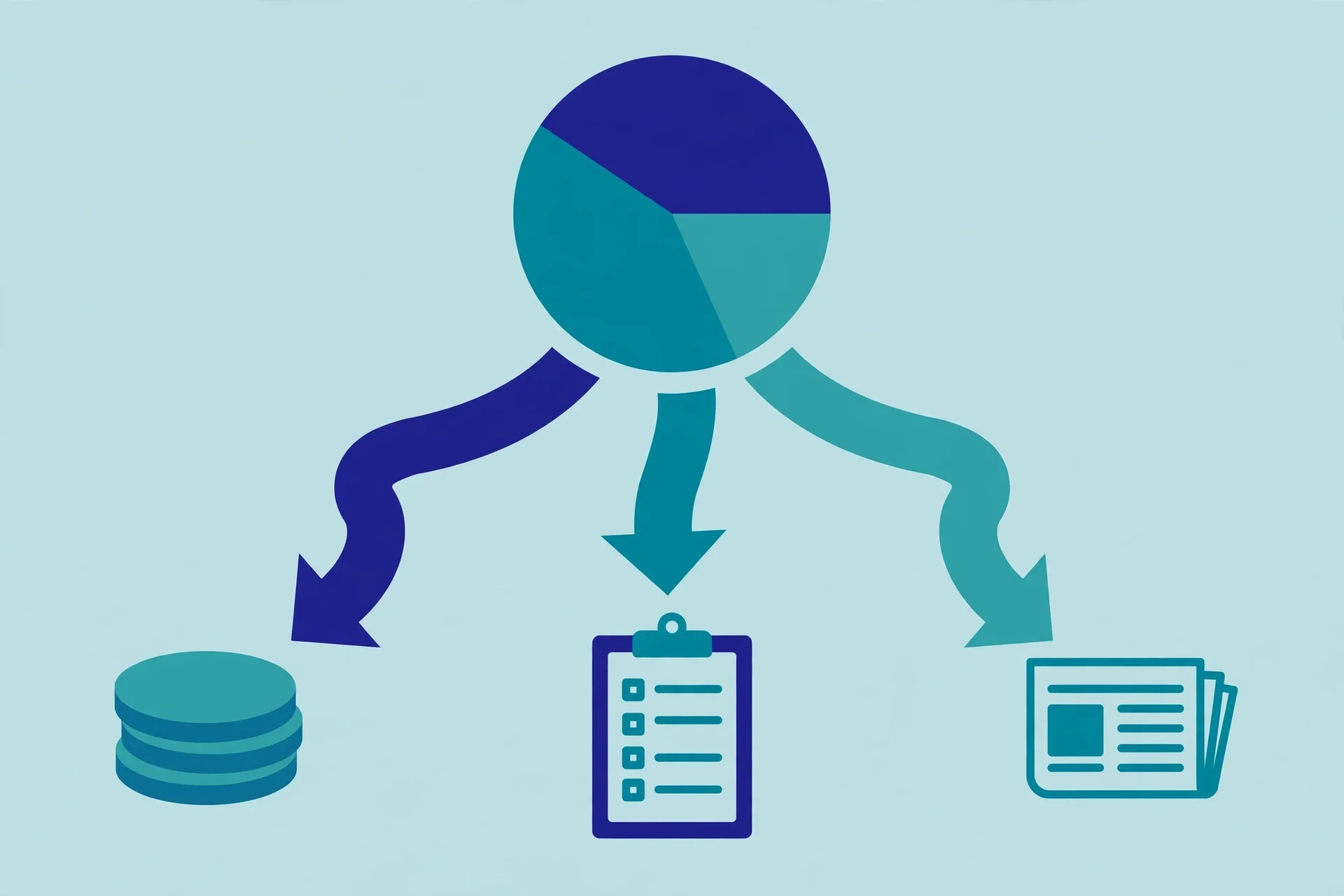
Take a small SaaS site with a 5,000 dollar monthly budget for three months, 15,000 dollars in total, and three ways to spend it, starting with the failure case most articles skip.
Option A is guest posting only: 10 guest posts at 500 dollars each, 10 links, all placed by the site itself, no journalist coverage and no brand mentions. The links arrive, but they are all placed content: no newsroom wrote about the company and no reader discovered it through a story. The site spent 15,000 dollars and bought exactly what it paid for, nothing more, which is a poor return for a business that needs visibility as well as links.
Option B is one digital PR campaign: 5,000 dollars for original survey data on 500 users, plus 5,000 dollars for design and a landing page, plus 5,000 dollars for pitching to 60 journalists, for 15,000 dollars total. This is the ambitious version, and it can also fail: if the survey question is dull, the sample is biased, or the pitch reaches the wrong journalists, the campaign earns no coverage at all. The site then has a nicely designed page nobody linked to, and 15,000 dollars spent for zero links. That failure happens to experienced teams, which is why no digital PR link building campaign can promise coverage.
Option C is the split this article recommends: 7,500 dollars on one data study pitched to 40 journalists, 5,000 dollars on two linkable assets, and 2,500 dollars on follow up pitching. The study carries the campaign, the two assets give journalists something to link to even if the study underperforms, and the follow up budget buys the second round of pitching that often lands the coverage the first round missed. It is still a gamble, but the risk is spread across three bets.
Then the arithmetic, labelled as an illustration from the BuzzStream figures, not a promise: at the most common cost band of 300 to 500 dollars per link, a 15,000 dollar campaign that earns 30 links costs 500 dollars per link, one that earns 10 links costs 1,500 dollars per link, and one that earns no coverage costs 15,000 dollars for zero links. The BuzzStream figure that 85.2 percent of practitioners see something measurable within six months does not mean most campaigns succeed, and it certainly does not mean yours will. In short, 15,000 dollars can buy 30 links, 10 links, or nothing, and the difference is the quality of the story, the sample, and the pitch, not the size of the budget.
The Honest Limits of Digital PR Link Building
No digital PR link building campaign can guarantee coverage or a followed link. Journalists decide what to write, and most pitches get no reply at all. A good story, a clean sample, and a careful pitch raise the odds, but they never remove the risk.
Cost per link varies widely. The 300 to 500 dollar band is the most common known band in the BuzzStream survey, not an average, and many teams do not know their cost at all. A campaign that earns 30 links looks cheap and one that earns two looks ruinous, and both can come from the same team in the same year. Budget for the campaign, not for a promised cost per link.
The survey figures here are practitioner opinion, and the correlation figures are correlation only. The 48.6 percent and 34 percent figures describe what SEOs think, not what they measured, and the Ahrefs 0.664 correlation shows two things moving together, not one causing the other. Read every number with its label attached.
A data study with a small or biased sample will not earn coverage, however well it is pitched. Journalists check who was surveyed and how, and a survey of 50 of your own customers is not a story about an industry. If you cannot afford a real sample, do not run a survey campaign: expert comment or a dataset built from public records may fit better.
Finally, treat this tactic as one part of broader link building strategies, not as the whole plan. A site that only runs digital PR campaigns will have gaps in months when no story lands, so pair campaigns with assets that earn links slowly on their own and outreach that does not depend on a journalist saying yes. The editorial links are worth chasing precisely because they are hard to earn, and a plan that depends on them alone is fragile.
Frequently Asked Questions
What is digital PR link building, in one sentence?
Digital PR link building is earning backlinks by giving journalists original data, a newsworthy story, or expert comment that they choose to cover, with a link back to your site as the source.
How is digital PR different from a press release?
A press release announces company news, like a launch or a funding round, and is distributed widely. Digital PR builds a story for readers first, usually original data, and pitches it to a small list of journalists who cover that topic. In Muck Rack's May 2026 analysis, press releases account for under 1 percent of AI citations while earned media accounts for 84 percent.
How much does a digital PR campaign cost?
BuzzStream's State of Digital PR 2026 report puts the most common known cost per link at 300 to 500 dollars, the agency side average around 750 dollars, and the median retainer around 5,458 dollars per month. A small campaign of one data study, a landing page, and pitching to 40 journalists can run around 15,000 dollars, but the cost per link depends entirely on how many links it earns, and a campaign with no coverage costs the full amount for zero links.
How long before a digital PR campaign shows results?
BuzzStream 2026 reports 81 percent of practitioners land first coverage within a week of pitching, but first coverage is not the same as a followed link. For measurable results, 85.2 percent see something within six months, and 51.4 percent say results take three to six months. Plan on three to six months before judging a campaign.
Can a small site do digital PR without an agency?
Yes, with a real story and the time to pitch it properly. A small site can run a survey with Google Forms or Typeform, publish the findings on one landing page, and pitch 40 journalists by hand. The cost is mostly time: finding the journalists, reading their work, and writing personal pitches. What it cannot do is fake a sample: a survey of a few dozen customers will not earn coverage, so pick a story the data can genuinely support, or use public data instead.
Does digital PR help with AI search visibility?
The evidence points that way, but it is correlation, not proof. Ahrefs found branded web mentions correlate with AI Overview visibility at 0.664 in its August 2025 study of 75,000 brands, against 0.218 for backlinks, and Muck Rack's May 2026 analysis of more than 25 million links found earned media accounts for 84 percent of AI citations. Neither proves a campaign will get your brand cited, so treat AI visibility as a likely benefit of good coverage, not a guaranteed outcome.
Order guest posts on reviewed websites with honest metrics, or list your own site and get paid.
Join RankPublish