How to Choose Backlinks Worth Paying For (and Which to Skip)
Two sellers offered links at 40 dollars and 450 dollars, and the cheap one was the bad deal. This guide shows how to choose backlinks with five checks, a worked comparison of three offers, and fair market prices.

Two sellers emailed the same site owner on the same morning. The first offered a link on a DR 62 blog for 40 dollars, delivered in 48 hours. The second offered a link on a DR 48 blog for 450 dollars, and asked for two weeks to place it properly. The owner bought the cheap one. Six months later that link sat on a page Google had never indexed, on a site whose traffic had fallen 90 percent. That is the whole problem with how to choose backlinks: the price tag tells you almost nothing.
The short answer
To choose backlinks well, check relevance first, then real organic traffic, then authority, then link placement, and then the health of the site over time. A link is worth paying for when the site covers your topic, gets real visitors from Google, and places your link inside a real article. Skip any link that fails two or more of those checks, whatever the price. The rest of this guide shows how to run each check in practice.
How to choose backlinks: a decision, not a shopping list
Most people shop for links the way they shop for phone chargers: find the cheapest one and buy it. A link is a vote of confidence from one site to another. A vote from a site Google trusts, on a topic Google already connects to your site, counts. A vote from a site nobody reads, on a topic with no connection to yours, counts for very little.
That is why how to choose backlinks is a decision problem, not a price comparison. Two links can have the same Domain Rating and cost ten times apart, because one sits on a real site with real readers and the other sits on a site built only to sell links. Look at the site the way Google does: its traffic, its content, and its history. A bad link rarely hurts you the week you buy it. It hurts months later, when an update discounts the site.
How to choose backlinks: the five checks that matter
Every link worth buying passes five checks, in this order, and that order is the core of how to choose backlinks. Buyers usually start with authority, the easiest number to fake, and end with relevance, the hardest to fake.
Relevance: does the site cover your topic in a way a real reader would expect? A link from a plumbing blog to a plumbing supplier makes sense. One from that blog to a casino does not.
Real traffic: does the site get visitors from Google search, and is that traffic stable or growing?
Authority: does the site have a believable Domain Rating or Domain Authority, earned over time? It matters only after relevance and traffic check out.
Placement: does your link sit inside the main text of a real article, where a reader might actually click it? A link buried in a footer or sidebar carries far less weight.
Site health: does the site look like a real publication, with recent articles and real authors? A healthy site keeps its links.
Relevance first: the check most buyers skip
Relevance is the first check because it is the one Google weighs most heavily, and the one sellers talk about least. A seller will always tell you the Domain Rating. They will rarely tell you that their site covers twelve unrelated topics.
Test relevance in two minutes. Read the last ten article titles. If fewer than seven relate to your topic, the site is a generalist at best. Then open the page where your link will appear and ask: would a reader of this page plausibly want to visit my site? If the answer is no, the link will not help you.
Check the page level too: a link from a general news site still counts if the article itself is about your topic.
For a local trade, the same logic applies: a moving company benefits far more from links on local business blogs and moving guides than from a high authority site about an unrelated subject, as our guide to buying backlinks for moving companies explains. When you are deciding how to choose backlinks for a local trade, relevance is the question of whether the linking page and your page belong in the same conversation.
Authority and traffic: reading the numbers honestly
Once relevance checks out, look at the numbers. Domain Rating, from Ahrefs, and Domain Authority, from Moz, are scores from 0 to 100 that estimate how strong a site's link profile is. They are useful as a first filter, not as a final verdict. A DR 50 site can be worthless, and a DR 30 site can be excellent, and the difference is almost always traffic.
Real organic traffic is the number that matters most after relevance. Use Ahrefs Site Explorer, Semrush, or a free traffic checker, and look at three things: monthly visitors from Google, whether that number is rising or falling, and which keywords bring those visitors. A site with 20,000 monthly visitors from real keywords in your niche is a far better link source than a site with a DR of 70 and 300 monthly visitors. Traffic proves that Google currently trusts the site enough to send it readers.
Watch the trend too: a site whose traffic fell from 50,000 to 5,000 in three months has a problem that will reach your link. Check the site's own link profile too: a score backed by hundreds of small, relevant sites is earned, while one backed by a handful of huge links is fragile. A good link comes from a site that earns its own links, which is why our guide to getting backlinks from high authority sites describes the same kind of site you should be willing to pay for.
A worked example: three offers, one clear pick
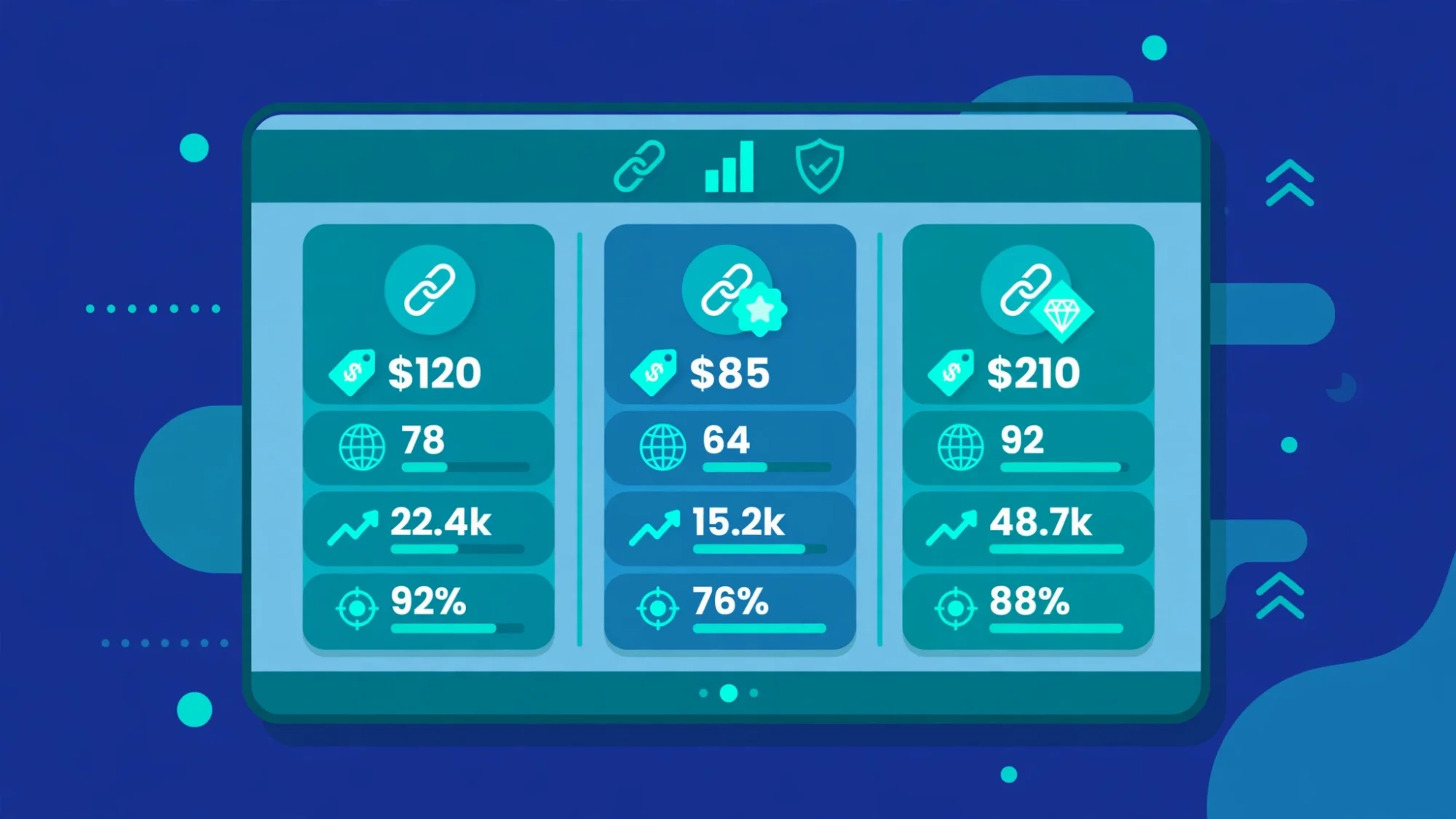
Here is a realistic comparison, with three offers for a link to a page about kitchen remodeling, each scored on the five checks.
Offer A costs 40 dollars, on a site with a DR of 62. Its traffic is 800 monthly visitors, down from 9,000 a year ago. It covers home improvement, finance, health, crypto, and pet care. Your link would go into a new 500 word article with four other paid links. The site publishes about 30 anonymous articles a week.
Offer B costs 450 dollars, on a site with a DR of 48. Its traffic is 18,000 monthly visitors, stable for eight months. It covers kitchens, bathrooms, and home renovation only. Your link would go into an existing article about kitchen renovation costs that already ranks on page one, getting about 1,200 visits a month. Your link would be the only paid placement on the page.
Offer C costs 180 dollars, on a site with a DR of 55 and 6,500 monthly visitors, growing slowly. It covers home improvement and real estate. Your link would go into a new article as one of two outbound links. The site publishes three articles a week, all with named authors.
Score them, and the picture flips. Offer A fails four checks: relevance, because the site covers everything, traffic, because 800 visitors and a 90 percent decline is a dying site, placement, because four paid links in one short article is a link farm pattern, and site health, because 30 anonymous articles a week is not a publication. Score: one out of five.
Offer B passes all five: exact relevance, real and stable traffic, modest but earned authority, excellent placement in an article that already ranks, and strong site health. Score: five out of five. Offer C passes four out of five, with placement the only weaker check.
The pick is Offer B, even though it costs more than ten times Offer A. Over a year, Offer B's link sits in a ranking article that sends referral traffic, while Offer A's sits on a page Google may never index. Offer C is a fair second choice if the budget does not stretch to 450 dollars. That is how to choose backlinks in practice: score the offer, not the sales email.
Red flags that mean walk away
Some offers do not need scoring. They need a refusal, because the warning signs are so strong that no price makes them acceptable.
A seller who guarantees a ranking or a position on page one is lying. No seller controls Google.
A site that publishes dozens of articles a day, across unrelated topics, with no named authors, exists to sell links.
A link hidden in a footer, a sidebar, or an author bio is worth far less than a link in the body of an article. A seller who will not show you the exact page before you pay is hiding something.
Finally, refuse any link that arrives with a bundle of other paid links on the same page. A link in a cluster of paid placements is a liability, not an asset. Our guide to toxic backlinks lists the patterns that mark a link as harmful.
A step by step vetting routine before you pay

Run this routine on every offer, in order, before any money changes hands. It takes about 20 minutes per site, and it filters out most bad offers by step four. It is the practical core of how to choose backlinks.
Step 1: read the site like a visitor. Check the last ten article titles and the about page. If there is no clear topic and no author names, stop here.
Step 2: check real traffic in Ahrefs, Semrush, or a free traffic tool. Note the monthly organic visitors, the six month trend, and the top keywords. Reject the site if traffic is under 500 a month, if it has fallen by more than half in six months, or if its top keywords are unrelated to your niche.
Step 3: check the authority score in context. Note the DR or DA, then look at the mix of linking domains. A believable score is backed by many small, relevant sites. A suspicious score is backed by a few huge links.
Step 4: inspect the exact page. Ask the seller for the URL where your link will appear. Check that the page is indexed by Google and that your link will sit inside the main text. If the page is not indexed, or the seller will not name the page, stop.
Step 5: count the other outbound links on the page. One or two links to relevant, reputable sites is a good home for yours. Ten outbound links to unrelated commercial pages marks a link farm page.
Step 6: check the site's history in the Wayback Machine. A site that covered one topic for years is a real site. A site that was a personal blog last year and a home improvement blog today has been repurposed to sell links.
Step 7: agree the terms in writing: price, page, anchor text, followed or nofollowed, and how long the link stays live. Ask for a replacement if the link is removed within twelve months.
After five or six runs you will spot a bad site in three minutes. That speed is the real return on learning how to choose backlinks properly.
What a fair price looks like
BuzzStream's 2026 study of more than 257,000 guest post sites found that a guest post costs 295 dollars on average direct, and 461 dollars on average through a vendor. The same study found that the average Domain Rating across the whole guest post marketplace is only 24, and that 78 percent of guest post sites see fewer than 1,000 organic visitors a month. Paying the market average for a below average site is the most common mistake in link buying.
A second dataset points the same way. Adsy's 2026 study of 52,671 websites found an average guest post cost of 459 dollars, with prices on high authority sites up 46 percent year over year. Ahrefs' small study of 450 sites found niche edits and sponsored guest posts cost 361.44 dollars on average. Three sources, three samples, one band: a real link costs a few hundred dollars, not a few dozen.
As a sense check, a link on a DR 40 to 60 site with real traffic usually falls between 150 and 400 dollars direct, or 300 to 700 dollars through a vendor, while a DR 70 or higher site with strong traffic can fairly cost 700 to 2,000 dollars or more.
What the data actually says about links and rankings
Backlinko's analysis of 11.8 million Google search results, conducted with Ahrefs data, found that the page in position one has on average 3.8 times more backlinks than the pages in positions two to ten. The same study found that unique referring domains, not total link count, had the stronger correlation with rankings. One link from a new, relevant domain is worth more than ten links from a domain that already links to you.
Ahrefs' research makes the same point from a different angle. Its analysis of around 920 million pages found that referring domains is the strongest correlating backlink metric for both rankings and organic traffic. Its study of one million keywords put the correlation between referring domains and rankings at 0.255, against 0.131 for Domain Rating alone. Domain Rating is a useful filter, but a weak predictor on its own, which is why this guide ranks it third.
Ahrefs also found that 66.31 percent of pages have no backlinks at all, and that 26.29 percent have links from three websites or fewer. A few good links puts a page ahead of most of the web. BuzzStream's study found that fewer than 2 percent of sites for sale qualify as genuinely high quality, which means 98 percent of what is offered to you is average or worse. Vet carefully, because the good 2 percent exists, and it is worth finding.
Honest limits: what vetting cannot do
A guide that only tells you how to buy well would be dishonest if it did not also tell you what buying cannot guarantee. So here are the limits, stated plainly.
No link guarantees a ranking. A good link improves your chances, sometimes a lot, but rankings depend on your content, your site's technical health, your competitors, and Google's algorithm. A seller who promises a position is selling a promise they cannot keep.
Vetting cannot catch everything. A site can pass all five checks today and be sold to a link farm operator next month. You reduce the risk with the checks in this guide, but you do not remove it, so check your paid links every few months to confirm they are still live and still followed.
Link buying costs more than the price of the link. Vetting takes 20 minutes per offer, and a careful buyer reviews five or ten offers to buy one link: two to three hours of work per link. At 300 to 500 dollars per link, ten links cost 3,000 to 5,000 dollars plus roughly a working week of vetting.
There is also a real risk of a manual action. Google's spam policies state clearly that buying or selling links to manipulate rankings violates its guidelines, and sites caught doing so can face a manual action that removes their pages from search results. The practical line is this: pay for genuine editorial placements, where the article is real and useful on its own, and never pay for links at scale or on irrelevant sites. Our guide to how to buy backlinks safely explains that line in detail.
Frequently asked questions
How many backlinks do I need to rank?
There is no fixed number: it depends on the keyword and on the pages already ranking for it. A lightly contested long tail keyword can be won with a handful of good links, while a competitive commercial term may need 50 or more referring domains. Count referring domains, not total links, and compare your page with the pages in positions four to ten.
Is it better to buy one expensive link or ten cheap ones?
One expensive link on a relevant site with real traffic is almost always better than ten cheap ones. Backlinko's study of 11.8 million results found that referring domain diversity matters more than raw count. Ten links from ten weak sites add ten weak signals. One link from a strong, relevant site adds one strong signal.
What is a good Domain Rating for a backlink?
There is no single good number, because Domain Rating only makes sense beside traffic and relevance. As a rough filter, a DR of 30 to 60 with real organic traffic in your niche is solid, and a DR above 60 with strong traffic is excellent. A DR of 70 with almost no traffic is a warning sign, not a prize. Always check traffic before you trust the score, which is the simplest rule in how to choose backlinks.
How do I check if a backlink is toxic?
Look for the patterns: the site covers unrelated topics, publishes dozens of articles a day with no authors, has traffic that collapsed after a Google update, or hosts many paid links on the same page. The full checklist is in our guide to toxic backlinks, which also explains how to disavow a link you cannot remove.
Should I buy backlinks at all, or earn them instead?
Earning links through good content, digital PR, and genuine outreach is safer and more durable. Buying links makes sense only for specific, high value pages where an editorial placement is genuinely useful and vetted. If you are choosing between buying ten links this month and earning five over three months, choose the five earned links.
The bottom line
Learning how to choose backlinks comes down to five checks: relevance, real traffic, authority, placement, and site health. Score every offer against those five, compare offers side by side, and let the cheapest option lose when it deserves to lose. A 450 dollar link on a real, relevant, ranking page beats a 40 dollar link on a dying generalist site every time.
Buy slowly, vet every offer, and keep your expectations honest. No link guarantees a ranking, and a real campaign costs real money and real time. But a small number of well chosen links, from sites your customers would actually read, is one of the most durable investments in SEO. That is the whole of how to choose backlinks: check, compare, and only then pay.
Order guest posts on reviewed websites with honest metrics, or list your own site and get paid.
Join RankPublish