Broken Link Building, Step by Step: Find Dead Links and Win the Replacement
Broken link building explained step by step: how to find dead pages with backlinks, build a better replacement, and win the link with an email that gets answered.

Every website on the internet has dead links. Pages move, sites close, and articles get deleted, but the links pointing to them stay where they are, sending visitors to a page that no longer exists. Broken link building is the tactic that turns that problem into an opportunity: you find a dead page that other sites still link to, you build a better replacement, and you ask those sites to link to you instead.
It is one of the oldest link building tactics, and one of the most honest. You are not asking a blogger for a favour. You are helping them fix a broken page on their own site. That is why it still works in 2026, and why it is worth learning properly, because done badly it is just another cold email, and done well it wins links that stay live for years.
If you are new to link building, read our plain words guide to
what link building is first, so the terms in this guide make sense, and check our guide to how to get backlinks without paying for every single one, because broken link building is one of the free methods it covers.
What broken link building is
Broken link building has four steps, and skipping any one of them is the usual reason a campaign fails. First, find a dead page with backlinks. Second, vet those backlinks, to check that they are worth winning. Third, create a replacement page that is at least as good as the dead one, and ideally better. Fourth, contact the sites that link to the dead page and ask them to swap the link to your replacement.
The key detail is the first step. Not every dead page is worth pursuing. A dead page with no backlinks is just a dead page. A dead page with two backlinks from tiny blogs is barely worth an email. The pages worth your time are the ones with dozens of backlinks from real sites, because each of those backlinks is a site you can contact, and each contact is a chance at a link.
Broken link building works best when the dead page was a resource: a guide, a list, a study, or a tool page that people linked to because it was useful. It works worst when the dead page was a product page, a news story, or a page that people linked to for a reason you cannot copy, like original research you would need a year to repeat. Learning to tell those two apart, before you write a word of content, is the skill that makes broken link building pay.
Step 1: Find broken pages with backlinks
There are four ways to find dead pages worth replacing, and you can start with free tools for the simplest one. The method you choose decides how much work the campaign takes, so pick the one that fits the tools you have.
The easiest way is to look for broken links on resource pages in your niche. Resource pages are lists of useful links on a topic, and their owners rarely update them, so they often link to dead pages. Search Google for your topic plus words like resources, links, or useful sites. Open the resource pages you find, and check their outbound links for dead ones. A
free link checker, or a browser extension that checks link status, will show you the broken ones in seconds. This method needs no paid tool, and it finds real opportunities, though each one usually has only a handful of linking sites.
The second way is to look for your competitors' broken pages. Every site that has been around for a while has dead pages, because content gets moved, deleted, or reorganised, and old URLs are often forgotten. Put a competing domain into a backlink checker, look at its pages sorted by referring domains, and filter for pages that return a 404 error. A dead page on a competitor's site with 30 or 50 sites linking to it is a ready made target list, because those 30 or 50 sites are your prospects.
The third way is to look for broken pages about a topic. This needs a paid tool with a large index of pages, because you are searching the whole web for dead pages on one topic with many backlinks. It finds the biggest opportunities, including dead pages you would never find by browsing, but it costs money, so save it for a campaign where the payoff justifies the spend.
The fourth way is to look for broken links on a competing website. Instead of finding dead pages that others link to, you find live pages on a competitor's site that link out to dead pages. Each dead link on that page is a page you could replace, and the competitor's page is proof that someone in your niche thought the topic was worth linking to. This method is useful when the first three find nothing, because it starts from pages that are already linking out.
Whichever way you choose, keep a list of every dead page you find, with its URL, its topic, and the number of sites linking to it. Then sort that list by the number of linking sites, and start with the top three. A campaign built around one strong dead page beats a campaign built around ten weak ones.
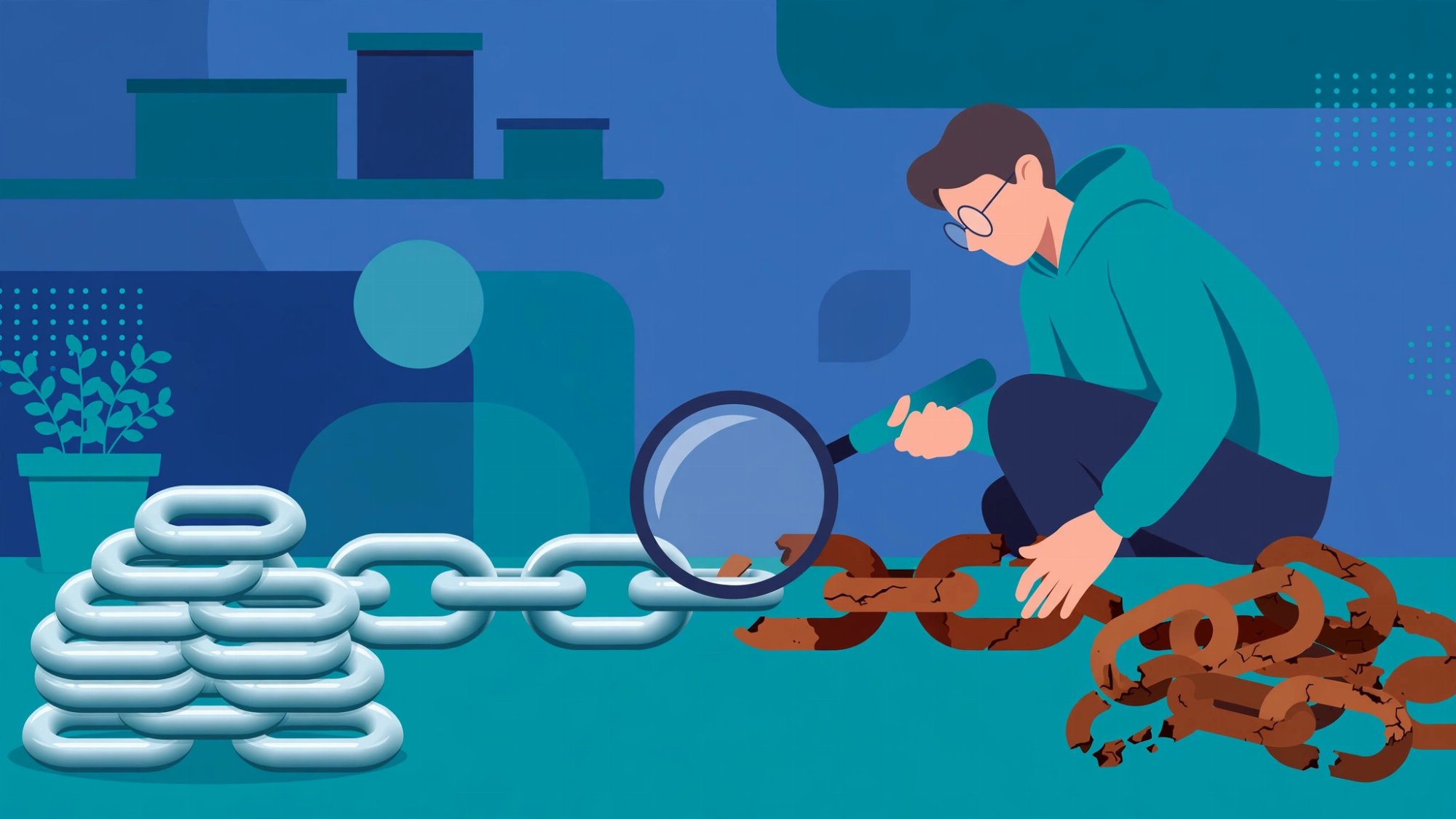
Step 2: Vet the backlinks before you build anything
Most people jump from finding a dead page straight to creating a replacement. That is a mistake, and it wastes the most expensive part of the campaign, which is the content. Vet the backlinks first, because a dead page can have 100 backlinks and still be worthless, if those links come from spam sites, or if people linked to it for a reason you cannot copy.
Check link quality first. Open the backlink report for the dead page, filter for one link per domain, and look at the linking sites. Are they real sites in your topic, with traffic and recent content? Or are they directories, forums, and sites that link to everything? A dead page with 20 links from real sites is worth more than a dead page with 200 links from spam. Our guide to
spammy backlinks explains how to spot the spammy ones, and if more than half the links look bad, drop the page and move to the next one on your list.
Then check why people linked to the dead page. This is the part most beginners skip, and it decides whether your replacement will work. Look at the anchor text and the sentence around each link. Some links are general: the anchor says "this guide" or "a useful post", and the context tells you nothing. Those links are easy to win, because any good replacement will do. Other links are deep: the anchor names a specific statistic, a specific step, or a specific example, and the context shows exactly what the linker valued. Those links tell you what your replacement must include, and if you skip that detail, your outreach email will fail, because the linker will compare your page to the dead one and find yours thinner.
If most of the links are deep, and they point to a specific piece of data you cannot reproduce, the opportunity is probably not worth it. A dead page that was linked to because it published an original study of a million pages cannot be replaced by a summary of that study. A dead page that was linked to because it explained a topic clearly can be replaced by a clearer explanation. Knowing the difference, before you build, saves you days of work.
Step 3: Create a replacement page that is genuinely better
Your replacement page has one job: to make the linker glad they swapped the link. That means it must cover the same topic as the dead page, answer the same question, and add something the dead page did not have. Copying the dead page word for word is not the goal. You can see what the dead page said by checking an archived copy in the Wayback Machine, and you should, because it tells you the structure to follow, but your page must stand on its own.
Start with the dead page's outline, then improve it in at least two ways. Add a worked example the dead page lacked. Add a template, a checklist, or a table that makes the advice easier to use. Update any numbers that are out of date, fix any errors, and add a section that answers the question readers ask next. These improvements are not decoration. They are what you mention in your outreach email, and they are the reason a linker says yes instead of ignoring you.
Make the page easy to link to. Give it a clear title that matches the topic, a short URL, and headings that show the structure at a glance. Keep the introduction short, so a linker who opens the page sees the value in ten seconds. And link out to two or three authoritative sources yourself, because a page that cites its sources looks like a resource, and a page that cites nothing looks like a sales page.
Do not publish the replacement until it is finished. A half finished page sent to 30 bloggers is 30 wasted pitches, and you cannot ask the same bloggers again next month with a better version. Take the extra day, finish the page, read it once as a stranger would, and only then start outreach.

Step 4: Do the outreach, and write an email that gets answered
Outreach for broken link building is simpler than most outreach, because you are offering help, not asking for a favour. The email should be short, specific, and honest about what you found. A good structure is four sentences: what you found, where you found it, what you built, and what you are asking for.
Start with the broken link itself. Name the page on the blogger's site, and name the dead page it links to. That proves you actually looked, and it tells the blogger exactly what to fix. Then, in one sentence, describe your replacement page, and name the one improvement that makes it worth linking to. Then ask, in one sentence, if they would consider swapping the link. Then stop. No attachment, no long pitch, no promise of exposure.
A typical reply rate for broken link building is 10 to 20 percent, which is higher than most outreach, because the email is useful even if the blogger says no. A typical link rate is 5 to 10 percent of the sites you contact, so 30 contacts should win you 2 or 3 links. Those numbers sound small, but the links are strong, because they come from pages that already link out, in your topic, and they tend to stay live.
Follow up once, after a week, with a shorter email that repeats the broken link and the replacement URL. Do not follow up a second time. Bloggers who do not reply to a useful email are busy, not rude, and a third email turns a helpful note into spam.
If a blogger replies and says they fixed the link but linked to someone else, thank them anyway. If they reply and say your page is not a good fit, ask what would make it a better fit, and remember the answer for your next campaign. Broken link building is a slow tactic, and the relationships it builds are worth as much as the links.
Mistakes that kill a broken link building campaign
The first mistake is chasing the wrong dead page. A page with many backlinks but no clear topic, or a page whose links come from spam, will eat a week of work and return nothing. Vet first, build second, and be willing to drop a page that fails the vetting.
The second mistake is building a thinner replacement. If your page is shorter, vaguer, or less useful than the dead page, no blogger will swap to it, and the ones who open it will remember your name for the wrong reason. Your page must be better, not just newer.
The third mistake is sending a generic email. An email that says "I found a broken link on your site" without naming the page or the dead link is a template, and bloggers delete templates. Name the page, name the dead link, and name your replacement. Specificity is the whole tactic.
The fourth mistake is contacting too few sites. Broken link building is a numbers game with a good conversion rate, but 5 contacts will not win you a link. Aim for 30 contacts per dead page, and if a dead page has fewer than 20 linking sites, find another dead page to add to the campaign.
The fifth mistake is treating a paid placement as broken link building. Some sites will offer to fix the broken link for a fee, and some services sell "broken link building" that is really paid placements on sites that link to dead pages on purpose. If money changes hands for the link,
Google treats it as a paid link, and the risk is the same as buying links. A real broken link campaign earns the link by helping the blogger, not by paying them.
Frequently asked questions
What is broken link building?
It is a link building tactic with four steps: find a dead page that other sites still link to, vet those backlinks, create a better replacement page, and ask the linking sites to swap their link to your page. It works because you are helping the site owner fix a broken link, not just asking for a favour.
Does broken link building still work in 2026?
Yes, but it is slower than it used to be, because more people use it and bloggers get more of these emails. It still works well for resource style pages, and the links it wins are strong, because they come from pages that already link out in your topic. Expect a link rate of 5 to 10 percent of the sites you contact.
How do I find broken link building opportunities without a paid tool?
Search for resource pages in your niche, open them, and check their outbound links for dead ones with a free link checker. Each dead link is an opportunity, and the resource page owner is your first prospect. You can also check a competitor's site for pages that return a 404 error, using a free backlink checker to see how many sites link to each dead page.
How many links can I get from one broken page?
It depends on how many sites link to the dead page, and how many of those links are worth winning. A dead page with 50 linking sites might win you 3 to 5 links. A dead page with 10 linking sites might win you none. That is why vetting matters: a campaign built around one strong dead page beats a campaign built around ten weak ones.
Is broken link building white hat?
Yes, when the link is earned by helping the site owner fix a broken link, with no payment for the placement. It becomes a paid link, with the risks that come with
paid links, if money changes hands for the link, so keep the outreach honest and the placement free.
How long does a broken link building campaign take?
Finding and vetting a dead page takes a day. Building a good replacement takes 2 to 4 days. Outreach and follow ups take 2 to 3 weeks. Rankings usually move 4 to 8 weeks after the links go live. It is a slow tactic, and that is why the links last.
The bottom line
Broken link building works because it starts with a real problem, a dead link on a real site, and offers a real fix. Find a dead page with backlinks worth winning, check why people linked to it, build a replacement that is genuinely better, and write an email that names the broken link and the fix in four short sentences.
Do that, for one strong dead page at a time, and you will win links that other tactics cannot reach, from sites that already link out in your topic, without paying for a single placement. It is slow work, and it is honest work, and those two facts are exactly why the links it wins keep working for years.
Order guest posts on reviewed websites with honest metrics, or list your own site and get paid.
Join RankPublish